
Authors: Mariah Schroeder BS & Phillip McMullen MD
Background
Cystic Fibrosis is an autosomal recessive disease that occurs when a child inherits pathogenic variants of the CFTR gene on chromosome 7 from each parent. There are over 2,000 CFTR variants that vary in disease severity. The most common pathogenic variant seen in Cystic Fibrosis is a deletion of the phenylalanine residue at the 508 position (F508del). The CFTR gene normally encodes for a chloride channel known as cystic fibrosis transmembrane conductance regulator (CFTR) protein which functions to transport chloride and sodium across epithelia. Mutations in the CFTR gene cause dysfunction of the CFTR protein, leading to disruptions in electrolyte and water transport and ultimately thick, viscous secretions affecting multiple organs including the lungs, pancreas, intestines, reproductive organs, and sweat glands. The cause of death in patients with Cystic Fibrosis is most commonly due to pulmonary disease, but manifestations in other organ systems are present as well.
| Lungs | Bronchiectasis and infections are common. Pulmonary hypertension may result in right heart failure. |
| Pancreas | Pancreatic dysfunction can lead to diabetes. |
| Liver | Bile duct plugging and, in advanced cases, cirrhosis. These can lead to complications such as portal hypertension, splenomegaly, and esophageal varices in advanced cases.
Liver dysfunction can also result in coagulation abnormalities, reduced bile production, and fat-soluble vitamin deficiencies. Of note, 25-30% of CF patients develop some degree of liver involvement, but only a small percentage progress to cirrhosis. |
Quick Tips at Time of Autopsy
Clinical History
- Many patients are aware of their CF diagnosis as all 50 states have screened newborns for CF since 2009.
- The newborn screening test for CF measures the level of trypsinogen in the patient’s blood and is confirmed with a sweat chloride test. A definitive diagnosis is made when concentrations of sweat chloride are ≥60 mmol/L but lower levels do not rule out CF.
- If a newborn screen is not performed, suggestive symptoms of CF include meconium ileus, steatorrhea, failure to thrive, and salty-tasting skin.
- Some adults (especially those born before 2009) may not be diagnosed with CF due to decreased severity of symptoms and can present with chronic cough, frequent pulmonary infections, nasal polyps, digital clubbing, and infertility.
External examination
- Respiratory tract involvement in CF can be observed externally in the form of a barrel chest which occurs from obstruction of the airway with mucus.
- Chronically low oxygen levels secondary to pulmonary disease can lead to digital clubbing.
- Due to long-term inflammation of the sinuses, nasal polyps may be present.
- Malnutrition due to pancreatic insufficiency may lead to muscle wasting and short stature.
- Palpate for salivary gland enlargement.
Internal examination
While all organ systems should be examined in CF, the ones most commonly affected include the lungs, pancreas, and hepatobiliary system.
Lungs
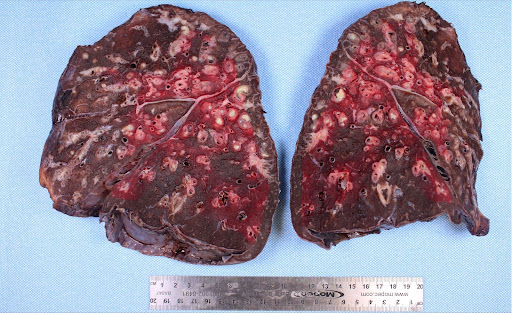
- Look for evidence of obstructive bronchopulmonary disease with bronchiectasis and pulmonary fibrosis. Cystic dilation of bronchi with viscous discharge can often be visualized.
- Pneumothorax and hemoptysis are also more common in CF patients as well as pulmonary infections.
- Some CF patients have undergone bilateral lung transplants; in these cases the gross and histologic findings of CF will not be seen in the lungs, but infections from immunosuppression and/or manifestations of acute or chronic allograft rejection (i.e. bronchiolitis obliterans and restrictive allograft syndrome) may be present.

 Images: Expand lungs in CF patients demonstrate bronchiectasis (dilated airways), and mucous plugging with thick secretions. (Image credits: Phillip McMullen/Loyola University Medical Center).
 Image: This transplanted lung demonstrates sequelae of transplant-associated complications in a CF patient including diffuse hemorrhage and pneumonia from immunosuppression. (Image: Meagan Chambers/Stanford University).
Pancreas
- The pancreas in CF patients is often small and fibrotic
Hepatobiliary System
- Early in the disease, bild duct plugging from viscous secretions may appear on cut surfaces of the liver as irregular areas of pallor/yellow discoloration reflecting fatty changes and/or yellow-green discoloration from biliary obstruction and bile stasis.
- Plugging can lead to portal hypertension and associated findings such as esophageal varices.
- Eventually these changes can lead to cirrhosis with its characteristic nodular appearance on cut sections and shrunken size. More severe bile retention may cause the liver to have a greenish hue, especially around the periportal areas.
Gastrointestinal
- Meconium ileus in infants can occur in infants with CF, and adults may also present with a distal ileal or colonic obstruction (clinically referred to as “distal GI obstruction syndrome”).
- Colonic strictures may be noted secondary to the use of pancreatic enzyme replacement therapy.
 Image: The distal small bowel shown here is dark and discolored from a distal small bowel obstruction in this CF patient. On opening, the contents of the bowel were described as thick and viscid. (Image credit: Meagan Chambers/Stanford University).
Heart
- Respiratory failure in patients with CF may lead to pulmonary hypertension and resulting cor pulmonale as evidenced by an enlarged and/or hypertrophied right ventricle.
Reproductive
- In females, cervical mucus may be thick with reduced water content.
- In males, the vas deferens may be closed or completely absent. Additionally, the seminal vesicles may be absent or dilated.
Ancillary Testing
-
- Genetic testing may be considered in patients that have a history of recurrent lung infections with previously mentioned signs and no prior CF diagnosis (such as in those born before routine testing started in 2009).
- Lung cultures should be done routinely at autopsy given the frequency of lung infections in CF patients
- S. aureus, H. influenzae, P. aeruginosa are the most common bacteria seen in lung infections and cause a predominantly neutrophil inflammatory response.
- Aspergillus fumigatus is the most common fungi associated with CF patients and may be within airways or in intra-cavity fungal balls.
Quick Tips at Time of Histology Evaluation
Respiratory
- Histologic examination of nasal polyps may show mucous cysts and hyperplastic mucous glands.
- Histologic changes in the airways lungs include mucus plugging, goblet cell hyperplasia in bronchial epithelium, submucosal gland hypertrophy, squamous metaplasia in airways (due to chronic irritation).
- Ectatic airways may demonstrate peribronchial fibrosis and in advanced cases loss/destruction of cartilage.
- Alveoli and small airways demonstrate increased fibrosis due to chronic irritation; in advanced cases this can take on a honeycombing appearance.
- Inflammation may be secondary to infection, or chronic damage and close histologic evaluation is warranted to properly characterize the underlying etiology of inflammation.
- Damage to vessels may result in hemorrhage and/or evidence of pulmonary hypertension.
 Image: Low power H&E section of lung in a CF patient who did not receive lung transplantation. Low power shows obvious end stage changes including fibrosis, loss of alveolar architecture, and large cystic spaces. (Image credit: Meagan Chambers/Stanford Hospital).
 Image: Low power H&E section of lung in a CF patient who did not receive lung transplantation. Low power shows obvious end stage changes including fibrosis, loss of alveolar architecture, and large cystic spaces. (Image credit: Meagan Chambers/Stanford Hospital).
 Image: Mucous plugs in airways are often denser in CF patients and more basophilic. Entrapped inflammatory cells (here scattered neutrophils can be seen) and denuded epithelial cells can be seen (Image credit: Meagan Chambers/Stanford Hospital).
Pancreas
- Obstruction of pancreatic ducts leads to release of lytic enzymes in the pancreas, causing autodigestion and loss of acini with fibrosis and fatty replacement. Residual dilated ducts may be filled with secretions.
- Destruction of the pancreas can lead to pancreatic insufficiency (with subsequent malnutrition), as well as loss of islets of Langerhans and resulting diabetes.
- Dilated intrapancreatic ducts may be visualized due to mucus plugging.
- Due to autodigestion, lobularization and fibrosis is seen with the formation of cysts. Grades of severity are described.
- Grade 1: accumulation of secretions
- Grade 2: exocrine atrophy
- Grade 3: atrophy with lipomatosis
- Grade 4: fibrosis with total obliteration of exocrine glands and ducts with scattered islet of Langerhans.
 Image: Low power (inset) of this pancreas shows that it is small and almost entirely replaced by fibrosis. Medium power view demonstrates extensive fibrosis with scattered acini. Rare islets were present but infrequent (not present in this image). And ducts were dilated (lower right hand corner of the image). (Image credit: Meagan Chambers/Stanford Hospital).
 Image: In this patient, the pancreas is almost completely gone, with extensive fatty replacement and rare acini remaining. (Image credit: Meagan Chambers/Stanford Hospital).
Hepatobiliary System
Accumulation of mucus can lead to obstructive biliary disease with bile stasis and proliferation of bile ducts. Additionally, periportal inflammation and fibrosis can result. Biliary stones may also form.
- Cholestasis: Intrahepatic bile accumulation can result in yellow-green bile plugs visible microscopically.
- Periportal Fibrosis: Progressive fibrosis begins in the periportal regions due to bile duct obstruction.
- Bile Duct Proliferation: Small bile ducts may proliferate as the liver attempts to compensate for obstruction.
- Inflammation: Chronic low-grade inflammation, particularly around portal tracts, may be present.
- Hepatosteatosis (macro steatosis): hepatic steatosis is the most frequent liver abnormality associated with CF, occurring in 20-60% of patients.
- Due to pancreatic insufficiency, CF patients often have deficiencies in essential fatty acids, choline, and other nutrients, contributing to fatty liver changes.
- Insulin resistance and diabetes further contribute to hepatic steatosis.
- Cirrhosis: In late stages, diffuse scarring and the loss of normal liver architecture occur.
 Image: Bile plugging in a CF patient’s liver. (Image credit: Meagan Chambers/Stanford Hospital).
Gastrointestinal
- Epithelial erosions
- Mucosal inflammatory infiltrates
- Viscous secretions in glands
Reproductive
- Mucus gland hyperplasia in the cervix (females)
- Dilated or absent epididymal tail, seminal vesicles, and vas deferens (males)
Kidneys
- New reports show compacted matter in the lumen of distal tubules which can calcify.
Quick Tips at Time of Reporting
- The most common cause of death in CF is respiratory failure (although “respiratory failure” should not be listed as the cause of death on the death certificate; its exact underlying conditions should be listed in detail).
- Examples of cause of death statements
- Chronic Pseudomonas aeruginosa infection due to end-stage cystic fibrosis lung disease.
Clinical Tidbits
- Due to the implementation of improving therapies and treatments, the median age of survival for people with CF has increased from 31 years for people born between 1993-1997 to 61 years for those born between 2019 and 2023. With increased survival autopsies are occuring on older and older patients.
Recommended References
- Grasemann, H., & Ratjen, F. (2023). Cystic fibrosis. New England Journal of Medicine, 389(18), 1693–1707. https://doi.org/10.1056/nejmra2216474
- Sheppard, M. N., & Nicholson, A. G. (2002). The pathology of Cystic Fibrosis. Current Diagnostic Pathology, 8(1), 50–59. https://doi.org/10.1054/cdip.2001.0088
Additional References
- Ratjen, F. (2023). The New England Journal of Medicine, 389 (18), 1693-1707. doi: 10.1056/NEJMra2216474.
- Stoyanov, G. S., Popov, H., Petkova, L., & Dzhenkov, D. L. (2019). The sixty-five roses of cystic fibrosis: A report of two autopsy cases with kidney involvement. Cureus. https://doi.org/10.7759/cureus.5641


