
Authors: Amanda Saunders MD MBA*, Sebastian Lucas BM BCh & John Walsh MD*
Background
Sickle Cell Disease (SCD) is the most common inherited blood disease in the United States and is frequently encountered at autopsy. It occurs when a child inherits two copies of a mutated hemoglobin gene and leads to a misfolded protein, structurally abnormal hemoglobin S which polymerizes under low oxygen tension, which leads to sickling of red blood cells in vessels. It is estimated that 70,000-100,000 Americans are affected with SCD and it occurs in 1/365 African American births. There are 3 main types of SCD which are the HbSS, HbSC and HbS-beta thalassaemia genotypes with SS being most prevalent. Sickle Cell Trait occurs when there is only 1 mutated copy of the gene and patients are typically asymptomatic. This occurs in 1/13 African American births. Usual HbSS and Hb beta-thalassaemia share similar autopsy pathology. HbSC (sickle C) is different. Patients are generally more stable and require less chronic medical interventions; however, unexpected acute crises can occur with rapid mortality.
The cause of death in patients with sickle cell disease can often be tied back to the pathophysiology of the sickle cells:
- Bacterial sepsis: leads to autosplenectomy caused by repeated infections and vasoocclusion. Moreover, the alternative complement pathway is affected in those with SCD which leads to reduced recruitment of neutrophils and puts these individuals at higher risk of disease from encapsulated organisms. (See the sepsis article for additional information).
- Acute chest syndrome (ACS) due to pulmonary arteriolar obstruction by sickled red blood cells or bone marrow embolism with thrombotic microangiopathy
- Chronic pulmonary vascular arteriopathy, pulmonary artery hypertension and cor pulmonale
- Cerebrovascular accident – infarction, intracerebral hemorrhage and subarachnoid hemorrhage
- Acute hepatic-splenic sequestration
- Acute and chronic renal failure
- Multi-organ failure following pan-body sickle crisis
- Deep vein thrombosis and pulmonary thromboembolism
- Dural venous sinus thrombosis and brain hemorrhage
- Aplastic marrow crisis from parvovirus B19 infection
Despite most individuals with sickle cell trait remaining asymptomatic, the incidence of cardio-respiratory arrest is over 20 times higher than the general public. Most of these instances occur during times of intense exertion and/or dehydration and it often is accompanied by rhabdomyolysis (Scheinin 2009). The autopsy in such cases is critical and the contribution of sickle cell trait to otherwise unexplained deaths should not be overlooked (Dyson & Boswell 2009).
Quick Tips at Time of Autopsy
Clinical History
- Patients may not know their sickle cell status due to an absence of standardized/mandatory universal testing. Thus, it is important to consider this in high-risk populations.
- Acute Chest Syndrome is a common cause of death if the episode progresses to respiratory failure and is most common in patients 1-3 days after hospitalization (most commonly vaso-occlusive crisis).
- Unexplained deaths in custody, athletes, and among military service members should raise concern for sickle cell. Military personnel with sickle cell trait historically had a higher sudden unexpected mortality until the pathophysiology was understood (Kark 1987) and hydration and other preventive measures could be applied. Similarly, athletes with sickle cell trait have suffered after extreme exertion. Similarly, death in custodies where there is restraint by officers with impairment of breathing may also trigger or contribute to the development of acute chest syndrome (Mitchell, 2018).
- Sickle disease can complicate and or compound other disease processes like ASCVD, or diabetes which need to be considered as a contributing factor.
- Depending on the circumstances, sickle cell disease may be of significant medicolegal importance, and consultation with the medical examiner’s office should be considered in some cases.

Image: a summary of pathology to look for at the time of autopsy. Overall, many sequelae of sickle cell are caused by small and large vessel obstruction in many organs. (Image credit: Sebastian Lucas).
External examination
- Due to the high frequency of sepsis in sickle cell patients, a blood culture should always be taken from neck veins or heart prior to incisions being made. Both aerobic and anaerobic cultures should be taken. (See “Ancillary Testing” below for additional information).
- Many sickle cell patients are underweight due to the increased metabolic demands from increased body protein turnover and resting metabolic rate (Reid, 2013).
- Leg ulcers may also be seen secondary to local thrombi, mechanical obstruction, or bacterial infection.

Image: Example of bilateral, synchronous ulcers in a patient with SCD. Notice the thin extremities, the darkening of the skin around the ulcer, the lack of hair and the dryness of the skin. (Image credit: Minniti 2016)
Internal examination
- While all organ systems should be examined in SCD, the ones with the most common sickle cell related morbidity are the lungs, liver and spleen, brain, heart, kidneys and bone marrow.
Lungs
- Look for evidence of pulmonary artery hypertension, thromboembolism, embolism of bone marrow, thrombotic obstruction of arteries, infection/pneumonia, and/or generalized congestion
- Fat emboli are also more common in patients with SCD than the general population as vaso-occlusive crisis in the long bones can lead to infarction of the marrow with subsequent marrow embolism.
- If there are thrombi in pulmonary arteries, the deep veins must be examined: IVC, pelvic veins, proximal femoral veins and calf veins. Histology of the thrombus is helpful in dating it, when present. Not all lung vessel thrombi originate as emboli from calf veins in patients with SCD; some are formed in the lung vessels as a consequence of chronic sickle pulmonary arteriopathy (native thrombi rather than emboli). Necrotic bone marrow embolism can also precipitate pulmonary arterial thrombosis.
Heart
- Examine the coronary arteries and check for left and right ventricular hypertrophy; high cardiac output due to chronic anemia can be associated with left ventricular hypertrophy +/-significant dilatation of left ventricle. The right ventricle is hypertrophied if there is pulmonary hypertension.
- Some SCD patients may die of acute MI yet have patent coronary arteries indicating the MI likely resulted from abnormal cardiac microcirculation.
Liver
- Patients with sickle cell disease may develop liver disease as a result of intrahepatic sickling of erythrocytes, viral hepatitis, iron overload from repeated transfusions, and pigmented gallstones secondary to chronic hemolysis
- As in other organs, the risk of thrombosis (e.g. a portal vein thrombosis) is increased.

Image: Sickle cell disease in a child, posterior abdomen view showing reddened pancreas (acute pancreatitis) and opened bile duct with numerous bile stones (black circle), blocking the pancreatic duct. (Image credit: Sebastian Lucas.)

Image: Sinusoidal congestion from sequestration can be seen macroscopically and microscopically. (Image credit: Sebastian Lucas).
Spleen
- The spleen has typically auto infarcted by adulthood and only a small remnant remains. However, acute massive sequestration may also cause enlargement (especially in younger patients who have not lost their spleen).
- Auto-splenectomy is caused by micro vascular occlusion and may be seen as early as age 5. Splenic sequestration typically occurs from age six months to 5 years and it is due to sickled RBCs getting trapped in the red pulp causing an obstruction of a larger draining vein.
- Hyposplenism can increase the risk for infections, including Pneumococcal sepsis and Salmonella sepsis

Image: Acute sequestration crisis in a young patient with enlarged spleen and liver from trapped red blood cells. (Image credit: Sebastian Lucas.)

Image: Three examples of involuting, small spleens in sickle cell patients. (Image credit: Sebastian Lucas.)

Image: The small (~4 cm), end-stage fibrotic residual spleen of an adult with sickle cell disease. (Image Credit: Utah Digital Pathology).

Image: Involuted spleen and congested liver in a patient with sickle cell disease. (Image credit: Sebastian Lucas.)
Kidneys
- Examine for pyelonephritis, papillary necrosis, cortical necrosis. Pyelonephritis and urinary tract infections are more common in SCD patients because of the functional asplenia and increased susceptibility to bacterial infections.

Image: Renal papillary necrosis in sickle cell disease. (Image credit: Sebastian Lucas.)
- Although very uncommon, sickle cell trait is associated with medullary carcinoma of the kidney.
Bone marrow
- Check for old and new vertebral/long bone infarcts, extent of hematopoietic marrow (hyperplasia), osteomyelitis
- If a long bone sickle crisis has been diagnosed clinically, it may be useful to remove 1 femur and split it longitudinally.

Image: Marrow expansion in the skull in a sickle cell patient. (Image credit: Sebastian Lucas).
Brain
- Old and recent ischemic strokes are common, as are intracerebral hemorrhage and primary subarachnoid hemorrhage (SAH). In all these pathologies it is useful to dissect out the circle of Willis for histopathology, which can show stenoses and medial degenerations +/- aneurysms – even if the circle of Willis looks normal to the naked eye. It is advisable to remove the circle of Willis, fix, and embed either whole in a large block, or cut up in smaller tissue blocks.
- Check the dural vein and basal vein sinuses for thrombosis
Muscle
- Sampling from muscles is important to look for histologic correlates of rhabdomyolysis
Ancillary Testing
- A blood smear on a glass slide can be done at the time of autopsy to demonstrate the presence of sickled cells. Of note, sickling can be seen as a postmortem effect in sickle trait patients, but the extent of sickling is usually amplified in cases of true sickle cell disease. (Thogmartin 2011)
- Blood may be necessary for a variety of tests including: bacterial cultures (both aerobic and anaerobic) and spun blood for serology such as parvovirus B19 virus.
- Whole blood can be taken if the red cell sickle status had not been evaluated prior to autopsy. Similarly, some patients that are labeled as having sickle trait may actually have the HbSC genotype that was not identified because the laboratory tests were incomplete. If there is uncertainty about the patient’s genotype, autopsy blood can be tested to reevaluate.
- Remember that illicit drug-related deaths are not infrequent in sickle patients, so standard toxicology needs to be considered. Opiates and opioids are taken daily by many sickle cell disease patients; overdoses are possible.
Quick Tips at Time of Histology Evaluation

Image: Placental histology shows sickling in maternal red blood cells (top half of image), but not in fetal red blood cells (lower left intravascular space). (Image credit: Sebastian Lucas.)
Lungs
- Acute chest syndrome
-
- This diagnosis is made mostly based on clinical findings, but histology can help support the diagnosis
-
- Two variations:
-
-
- Type A: severe distension of arterioles, capillaries and venules with sickled RBCs and signs of local infarction
-
-
-
- Type B: Emboli of necrotic bone marrow to small pulmonary arteries leading to intravascular sickling, thrombosis and acute cor pulmonale
-
-
- The key feature of acute chest syndrome in sickle cell trait patients is pan-lobe severe congestion and distension of lung capillaries and post-capillary venules by sickle red cells, far more than seen in normal post-mortem congestion. This is necessarily subjective, but in histologically severe cases provide evidence supporting an acute chest syndrome.

Image: Lung in the acute chest syndrome. Alveolar capillaries and venules are stuffed with sickled red cells. (Image credit: Sebastian Lucas).

Image: Lung in acute chest syndrome, massive capillary distention by sickle red cells. (Image credit: Sebastian Lucas.)

Image: Small pulmonary arteries with embolization of necrotic marrow and fat globules, which precipitated an acute chest syndrome (type B).Oil Red O staining on frozen tissue may assist in difficult cases of marrow/fat embolism. (Image credit: Sebastian Lucas.)
- Chronic sickle cell pulmonary arteriopathy
- Common cause of pulmonary artery hypertension in patients with SCD

Image: Chronic sickle pulmonary arteriopathy. Severely thickened pulmonary small arteries, causing pulmonary hypertension. (Image credit: Sebastian Lucas.)

Image: Same case, with elastic van Gieson stain showing irregular elastic reduplication and intimal fibrosis (Image credit: Sebastian Lucas.)

Image: Alveolar air spaces in the lung with abundant sickled red blood cells from an autopsy with a fatal sickle cell crisis. (Image credit: Meagan Chambers, University of Washington).
Spleen
- Histologic findings in splenic sequestration include expansion of the red pulp, with tightly packed sickled RBCs.

Image: Acute sequestration, spleen sinusoids packed with immovable sickle red cells. (Image credit: Sebastian Lucas.)
- Histologic findings in older patients with a small spleen include progressive changes secondary to vascular damage, including
-
- Decreased white pulp including lower lymphoid follicle density and fewer marginal zones. (This finding is in keeping with the clinical observation of impaired immunologic functions against blood-borne bacteria).
-
- Increased microvessel density (which can be demonstrated with CD34 and/or SMA staining)
-
- Fibrosis (especially in the red pulp) and Gamma-Gandy Bodies: foci of hemorrhage/hemosiderin, fibrosis, and calcium. (They are caused by infarction of spleen tissue).
-
- Red pulp macrophages are hypertrophied and can be seen to phagocytose red cells.

Image: Example of a Gamma-Gandy nodule. (Image Credit: American Society of Hematology)

Image: Additional example of gamma gandy nodules. (Image credit: Sebastian Lucas.)

Image: Two low power (2x) views of the spleen. The left is from a healthy/non-sickle cell patient, and the right is from a sickle cell autopsy patient. The sickle cell spleen on the right demonstrates decreased white pulp. (Image credit: Meagan Chambers/University of Washington).
Liver
- Severe congestion and expansion of the sinusoids can be seen due to hepatic sequestration

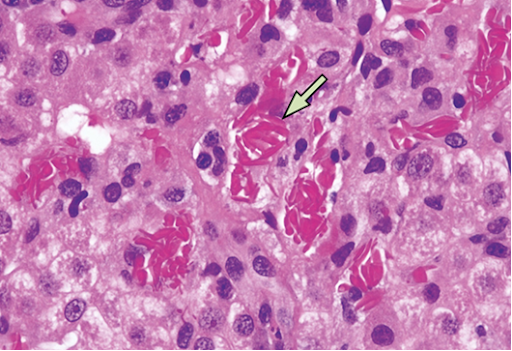
Image: Intermediate magnification micrograph of sickled red blood cells in sinuses. (Image Credit: Colli 2018).

Image: Perls stain (for iron) on the liver of a sickle cell patient with severe hemosiderosis. There is also increased background fibrosis. (Image credit: Sebastian Lucas.)
Bone marrow
- Marrow hypercellularity is normal in SCD as a compensatory change from the hemolytic anemia, as is a degree of macrophage hemophagocytosis, widening of the medullary cavities, and thinning of the bone cortex (the latter can lead to characteristic skull and vertebral deformities)
- Previous bone trabecular infarcts (the cause of the painful sickle crisis) are recognizable from the ragged reactive bone formation which is non-laminar. Acute bone infarcts show empty osteocyte lacunae. Marrow infarction might be mistaken for autolysis, but comparing non-infarcted more normal zones with the paler damaged zones reveals the difference. The hematopoietic cells and macrophages shrink, become paler and their nuclei disappear.
-
- Occasionally, these infarcts can act as a nidus for infection/osteomyelitis

Image: Hypercellular marrow with little fat (left). Increased numbers of macrophages in bone marrow (right, circles). (Image credit: Sebastian Lucas).

Image: Marrow infarct (left) and bone infarct with loss of nuclei in lacunes (right). (Image credit: Sebastian Lucas).
Heart
- Rarely, SCD patients die of acute heart failure with no obvious gross or microscopic abnormalities. This mirrors accounts of clinical heart failure in children and adults where imaging suggests abnormal physiology – but for which we have no simple morphological explanation. See the Appendix in: Herlihy & Lucas 2022. Evidence at autopsy may be limited to sickled cells in other organs (as shown above in various photos). This can be easily missed, especially in sickle cell trait patients where the underlying trait is not known prior to death.
Muscle
- A secondary feature in many exertional HbAS crises is rhabdomyolysis. Sampling the quads and psoas muscle may demonstrate histologic evidence of this.
Brain – Circle of Willis
- The CoW undergoes both intimal thickening and medial degeneration due to the chronic impact of sickle red cells on the endothelium. These are associated with ischemic stroke and/or subarachnoid hemorrhage.

Image. Cerebral arteries, some normal, others dilated and thin-walled. The elastic (black) stain highlights the medial damage leading to both thinning and intimal thickening. (Image credit: Sebastian Lucas).
Quick Tips at Time of Reporting
- Simply because the patient has SCD does not mean this contributed to their death. It is critical to distinguish whether SCD is the cause of death, played a contributory role or was irrelevant to the cause of death.
- Typically sickle cell trait is not fatal. However, there are exceptions such as cardio-pulmonary collapse from a sickle cell chest crisis secondary to stress.
- Death in sickle cell patients is frequently unexpected (about 40% of cases) and many deaths occur within 24 hours of presentation of acute disease (about 28% of deaths).
- Example Cause of Death Statements:
-
- Anemia due to hepatosplenic-sequestration due to sickle cell disease.
-
- Sepsis due to autosplenectomy due to sickle cell disease.
-
- Cor pulmonale due to chronic sickle pulmonary arteriopathy due to sickle cell disease.
-
- Subarachnoid hemorrhage due to sickle cerebral arteriopathy
- Alternatively, less common fatal sickle disease scenarios should also be considered when the diagnosis is known/confirmed at autopsy
-
- Hyperhemolysis syndrome. Not well understood; it manifests when during a sickle crisis with anemia, giving transfused red cells does not prevent the hemoglobin level dropping further, resulting in death from anemia. Pathologically, there is enhanced hemophagocytosis of red cells, best visualized in liver and bone marrow.

Image: Enlarged liver and spleen in sickle patient who died of hyperhaemolysis syndrome. (Image credit: Sebastian Lucas).

Image: The same patient, liver showing marked enlargement of sinusoidal Kupffer cells which have phagocytosed many erythrocytes. (Image credit: Sebastian Lucas).

Image: The same case. Liver with anti-CD68 IHC demonstrating enlargement of Kupffer cells. (Image credit: Sebastian Lucas).
- Gall stone disease with cholestasis or acute pancreatitis
- Multiorgan hemosiderosis, following years of supportive blood transfusions. Liver hepatocytes (as well as Kupffer cells), kidney tubules and heart myofibers can be severely affected.
- Bone marrow aplastic crisis from B19 infection, usually seen in children

Image: Bone marrow in B19 infection. Characteristic intranuclear inclusions in erythroblasts. (Image credit: Sebastian Lucas).
- Third trimester pregnancy has a high risk of acute chest syndrome as well as pulmonary thromboembolism
- Patients who refuse blood transfusions; this has resulted in their death, particularly in conjunction with pregnancy.
Recommended References
- Lucas S, Herlihy N. Autopsy in Sickle Cell Disease and Sickle Trait. Royal College of Pathologists. August 2023. Available here.
- Pizzi M, Fuligni F, Santoro L, Sabattini E, Ichino M, De Vito R, Zucchetta P, Colombatti R, Sainati L, Gamba P, Alaggio R. Spleen histology in children with sickle cell disease and hereditary spherocytosis: hints on the disease pathophysiology. Hum Pathol. 2017 Feb;60:95-103. doi: 10.1016/j.humpath.2016.09.028. Epub 2016 Oct 19. PMID: 27771375.
- Scheinin L, Wetli CV. Sudden death and sickle cell trait: medicolegal considerations and implications. Am J Forensic Med Pathol. 2009 Jun;30(2):204-8. doi: 10.1097/PAF.0b013e318187dfcd. PMID: 19465821.
Additional References
- Brousse, Valentine, Pierre Buffet, and David Rees. “The spleen and sickle cell disease: the sick (led) spleen.” British journal of haematology 166.2 (2014): 165-176.
- Dyson S, Boswell G. “Sickle cell and deaths in custody”. Whiting & Burch, UK, 2009)
- Gladwin, Mark T., and Elliott Vichinsky. “Pulmonary complications of sickle cell disease.” New England journal of medicine 359.21 (2008): 2254-2265.
- Manci, Elizabeth A., et al. “Causes of death in sickle cell disease: an autopsy study.” British journal of haematology 123.2 (2003): 359-365.
- Ogun, Gabriel Olabiyi, Henry Ebili, and Taiwo Racheal Kotila. “Autopsy findings and pattern of mortality in Nigerian sickle cell disease patients.” Pan African Medical Journal 18.1 (2014).
- Piubelli, Mario Luiz Marques, Leticia Campos Clemente, and Amaro Nunes Duarte-Neto. “Gamna-Gandy bodies of the spleen in sickle cell disease.” Autopsy & Case Reports 9.2 (2019).
- Theocharidou, Eleni, and Abid R. Suddle. “The liver in sickle cell disease.” Clinics in liver disease 23.2 (2019): 177-189.
- Thogmartin JR, Wilson CI, Palma NA, Ignacio SS, Shuman MJ, Flannagan LM. Sickle cell trait-associated deaths: a case series with a review of the literature. J Forensic Sci. 2011 Sep;56(5):1352-60. doi: 10.1111/j.1556-4029.2011.01774.x. Epub 2011 Apr 11. PMID: 21480898.
*The views expressed in this article are those of the author and do not necessarily reflect the official policy or position of the Department of Navy, Armed Forces Medical Examiner System, Uniformed Services University of Health Science, DHA, Department of Defense, or the US Government. The authors report no conflict of interest or sources of funding.


